
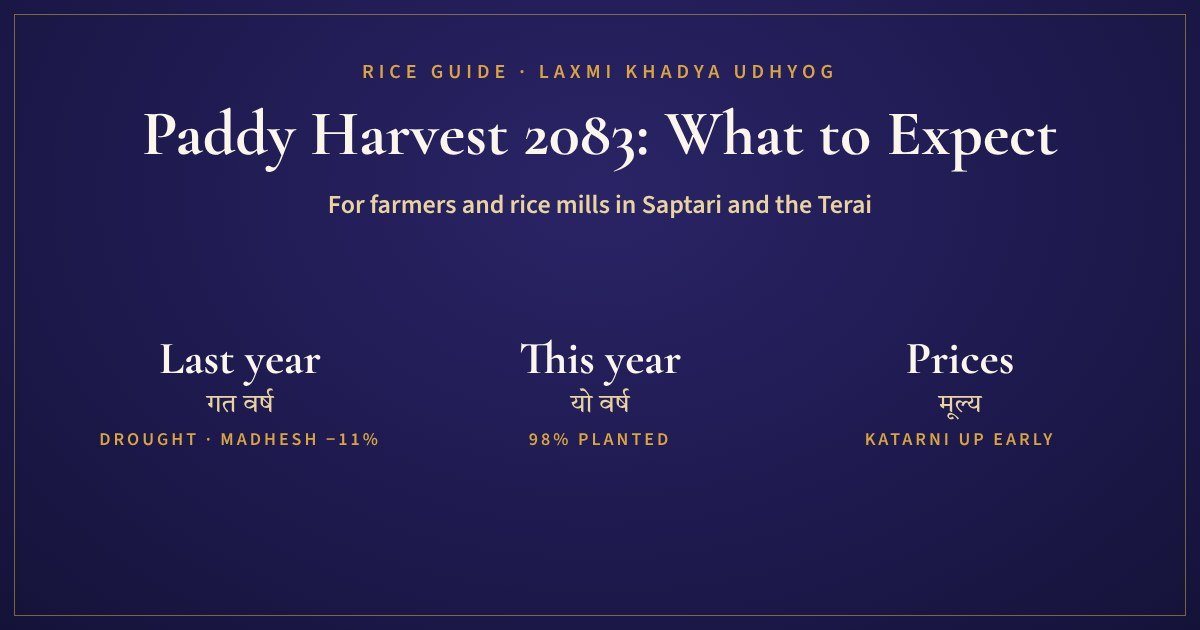
The new paddy is coming in across the Terai, and after a bad year the mood in the market has changed. This piece looks at the season at three levels: Nepal as a whole, Madhesh Province, and our own district, Saptari, where our mill is. I have used published figures wherever they exist and been clear where something is what we are seeing in the trade rather than an official number.
Nepal: a recovery after last year’s fall
Last season was the first in four years in which Nepal’s paddy output fell. It dropped about 4.2% to roughly 5.75 million tonnes, from a record 5.95 million tonnes the year before, mainly because of drought in Madhesh during planting and unseasonal October rain that damaged crops on about 20,000 hectares.[1] Even in a good year Nepal does not grow enough. The country needs about 7 million tonnes of paddy a year,[3] and it imported about Rs 39.5 billion worth of rice and paddy last fiscal year.[14]
This season started badly too. The monsoon arrived about a week late, around 19 June, with forecasts of below-average rain, and farmers faced higher diesel, ploughing and labour costs and shortages of urea and DAP.[3] But the rain did come. By late August about 98% of the national paddy area had been planted, slightly ahead of the same time last year, and the Department of Agriculture said conditions were better than last year.[4] Early harvest figures point the same way. In Chitwan’s paddy zone, officials expect about 50,000 tonnes against 45,000 last year, roughly an 11% rise.[7] The government’s first national estimate usually comes out early in the new year.
Madhesh: the province that lost most last year
Madhesh is Nepal’s biggest paddy-growing province, and it took the worst of last year’s drought. Its production fell about 11.4%, to around 1.31 million tonnes.[2] This year eastern Madhesh was again forecast to get below-average rain,[3] so many farmers went into the season nervous.
Planting recovered faster than expected. By 1 August about 91.6% of Madhesh’s roughly 382,000 hectares of paddy land had been transplanted,[5] and by late August the province was at 98.1%.[4] Because last year was so poor, the improvement in Madhesh this year should be much larger than the national average.
Saptari: a much better crop
Saptari grows paddy on about 68,000 hectares in an average year. Its southern part has canal irrigation, while the north depends almost entirely on rain.[6] That is why last year’s dry spell hurt the north of the district so badly.
This year costs were the early worry. Tractor ploughing in Saptari rose from about Rs 250 to Rs 600 per kattha, and some farmers waited for fertiliser before they could transplant.[3] Then steady rain in Asar and Shrawan filled the fields. About 72% of the district was transplanted by the first week of Shrawan, with the rain-fed north benefiting most, and the chief of Saptari’s Agriculture Knowledge Centre said he expected production to rise.[6]
That is what we are seeing. From the paddy coming in around Ranjitpur, yields this year look roughly 40 to 50% higher than last year. To be clear, that is what we are seeing locally, compared with a drought-hit crop, not an official figure. For farmers, a bigger crop is good news. For mills, it means more paddy to dry, store and finance in a short window, and more paddy arriving at once can put pressure on prices later in the season.
Prices: katarni (jeera masino) is the big story
Across the Terai, everyone is talking about katarni, the fine aromatic paddy that many people also call jeera masino. Its price jumped sharply right at the start of the season. These are open-market rates at rice mills in Birgunj, Narayanghat, Bayalbas, Itahari and Biratnagar, the main milling centres that set the tone for the country, not government prices:
| Katarni / jeera masino (open market, mill rates) | Start of season | Now | Change |
|---|---|---|---|
| Paddy (per quintal) | about Rs 3,500 | about Rs 4,900–5,000 | up about 40–43% |
| Rice (per quintal) | about Rs 6,800–7,000 | about Rs 9,000–9,100 | up about 30% |
In a few weeks katarni paddy has gone up by roughly Rs 1,400–1,500 a quintal, and the rice made from it by roughly Rs 2,100–2,200. Paddy has risen faster than rice, which squeezes mills in the middle, including smaller mills in districts like Saptari that buy at these market rates.
Why katarni prices jumped
There isn’t one cause. Several things are pushing in the same direction.
Thin stocks after last year’s drought. With Madhesh producing about 11% less paddy last season,[2] very little old katarni was left in godowns when the new crop arrived, so the first lots are being competed for.
Fine rice was already getting dearer all year. Between Asar and the end of Bhadra, retail jeera masino rose by about Rs 400–500 per 25 kg bag, to around Rs 2,500–2,700. Traders and industrialists blamed changes in Indian paddy prices, Indian export policy and transport costs.[11] When the finished rice is already expensive, mills can pay more for paddy.
Fuel and transport costs. Diesel rose about 60% in the three months to May, and average cargo transport costs went up about 17%. Paddy imported from India became about Rs 100 a quintal dearer.[12]
Supply disruptions. Floods in early September cut major highways into Kathmandu, and jeera masino in 20 kg bags went from about Rs 2,400 to Rs 2,600–2,700 there.[13]
Dependence on India. Indian policy changes on rice exports have moved Nepali prices quickly in the past. After India’s 2023 restrictions, for example, pearl jeera masino went from about Rs 1,600 to Rs 2,400 a bag.[15] Buyers react fast to any sign of tighter supply across the border.
Higher growing costs. Ploughing, seed, fertiliser and labour all cost more this year,[3] and farmers want that reflected in the price.
Festival demand and no price floor. The first katarni of the season arrives just before Dashain and Tihar, when demand for good rice peaks, and the government sets no minimum support price for fine paddy, so its price is whatever the market will pay.[9]
As the bulk of the harvest comes in, it would not be surprising to see the early premium ease, but with stocks this thin and costs this high, nobody can promise that.
Support prices and government buying
For monsoon paddy this year, the government has set the minimum support price at Rs 3,660 per quintal for coarse (mota) paddy and Rs 3,860 per quintal for medium paddy.[8] Last year it was about Rs 3,464 for coarse and Rs 3,628 for common paddy,[9] so that is a rise of roughly 6%. The government also plans to buy about 15,000 tonnes of paddy, worth around Rs 67.5 crore, at these prices, starting between Dashain and Tihar.[10] That is useful as a floor, but small next to a national harvest of several million tonnes, so for most farmers in Madhesh the support price is a reference point rather than a guaranteed buyer. It also doesn’t cover katarni at all.
What to watch over the next few weeks
Rain at harvest. Late rain is the biggest risk across the Terai. Farmers in other districts are already rushing to bring in paddy because of rain forecasts.[16] Saptari knows this risk well: in Kartik 2078, continuous rain soaked cut paddy across 18 municipalities and cut the district’s production by about a fifth.[17]
Drying and moisture. Well-dried paddy stores better and mills better, with fewer broken grains. If you can, dry it properly before you sell.
Labour during the festivals. Harvest and Dashain–Tihar overlap this year, and workers and machines are hard to find.[16] Book threshers and labour early.
Costs against prices. With ploughing, fertiliser and labour all dearer,[3] a bigger harvest does not automatically mean a bigger profit. Work out your real cost per quintal before agreeing a price, and if you grow katarni, consider selling in stages and keeping it separate from coarse paddy.
Talk to us
We are Laxmi Khadya Udhyog, a rice mill in Ranjitpur, Khadak-5, Saptari. If you are a farmer or trader in Saptari or elsewhere in Madhesh and want to talk about paddy this season, call or WhatsApp us on 980-4797292, or see our contact page.
Sources
- The Kathmandu Post, “Nepal’s paddy output set to fall for first time in four years,” 20 January 2026. kathmandupost.com
- AgriInsite (from Rising Nepal / Ministry of Agriculture and Livestock Development), “Decline in paddy production puts rice self-reliance at risk,” 19 January 2026. agriinsite.com
- The Kathmandu Post, “Nepali farmers battle surging plantation costs as delayed monsoon dims paddy outlook,” 28 June 2026. kathmandupost.com
- Khabarhub, “About 98 percent of paddy sowing completed across Nepal,” 22 August 2026. english.khabarhub.com
- The Rising Nepal, “Paddy transplantation reaches 91.55 percent in Madhesh,” 1 August 2026. risingnepaldaily.com
- Gorkhapatra, “सप्तरीमा ७२ प्रतिशत धान रोपाइँ सम्पन्न” (72% of Saptari’s paddy transplanted), Shrawan 2083. www.gorkhapatraonline.com
- Sankalpa Khabar, “धान ‘जोन’मा उत्पादन बढ्यो” (Chitwan paddy zone output), 28 October 2026. www.sankalpakhabar.com
- Onlinekhabar, “सरकारले तोक्यो बर्खे धानबालीको समर्थन मूल्य” (monsoon paddy support price), 25 May 2026. www.onlinekhabar.com
- The Kathmandu Post, “Paddy floor price for 2025-26 harvest goes up over 1 percent,” 15 August 2025. kathmandupost.com
- Annapurna Post, “सरकारले चालु आर्थिक वर्षमा ६७ करोडको धान खरिद गर्ने” (government paddy purchase plan), Asoj 2083. www.annapurnapost.com
- Annapurna Post, “चाडपर्वको मुखमा उपभोग्य वस्तुको अनियन्त्रित मूल्यवृद्धि” (price rises before the festivals), Asoj 2083. www.annapurnapost.com
- The Kathmandu Post, “From fuel to food, West Asia turmoil sends prices soaring in Nepal,” 25 May 2026. kathmandupost.com
- Daksu Media, “बाढीपछि महँगीको मार” (prices up after the floods), 3 September 2026. www.daksumedia.com
- The Kathmandu Post, “Food is now Nepal’s next biggest dependency after fuel,” 27 July 2026. kathmandupost.com
- The Kathmandu Post, “India’s protectionist policies squeeze Nepali markets and raise food security fears,” 15 May 2026. kathmandupost.com
- Beema Darpan, “पानी पर्ने डरले किसानलाई धान भित्र्याउन भ्याइ नभ्याइ” (harvest-time rain worries), 29 October 2026. beemadarpan.com
- Nepal Naksa, “लगातारको वर्षाले सप्तरीमा धानबालीमा क्षति” (rain damage to Saptari paddy), Kartik 2078. nepalnaksa.com
The 40–50% yield increase is what we are seeing locally around our mill in Saptari. The katarni / jeera masino prices are open-market rates at mills in Birgunj, Narayanghat, Bayalbas, Itahari and Biratnagar. Neither is a government rate or official statistic. Everything else is from the sources above, and prices can change quickly during the harvest. — Mukesh, Laxmi Khadya Udhyog
सारांश (नेपालीमा)
नेपाल: गत वर्ष धान उत्पादन करिब ४.२ प्रतिशतले घटेर ५७.५ लाख टन पुगेको थियो। यस वर्ष मनसुन ढिलो आए पनि देशभर झण्डै ९८ प्रतिशत क्षेत्रमा रोपाइँ भयो र अवस्था गत वर्षभन्दा राम्रो छ। मधेश: गत वर्षको खडेरीले उत्पादन करिब ११ प्रतिशतले घटेको थियो, यस वर्ष रोपाइँ ९८ प्रतिशत पुग्यो। सप्तरी: असार–साउनको वर्षाले रोपाइँ राम्रो भयो र रञ्जितपुर वरपर उत्पादन गत वर्षभन्दा करिब ४०–५० प्रतिशत बढी देखिएको छ (आधिकारिक तथ्यांक होइन)। मूल्य: वीरगंज, नारायणघाट, बयलबास, इटहरी र विराटनगरका मिलहरूमा खुला बजारमा कतरनी (जीरा मसिनो) धान प्रतिक्विन्टल करिब रु. ३,५०० बाट रु. ४,९००–५,००० र चामल रु. ६,८००–७,००० बाट रु. ९,०००–९,१०० पुगेको छ। कम मौज्दात, इन्धन र ढुवानी खर्च, बाढी, भारतमाथिको निर्भरता, उत्पादन लागत र चाडपर्वको माग यसका मुख्य कारण हुन्। सरकारले मोटो धानको समर्थन मूल्य रु. ३,६६० र मध्यमको रु. ३,८६० तोकेको छ।