
Buy rice anywhere in the Terai and the shopkeeper’s first question usually isn’t about the variety. It’s aruwa ki usina? The answer changes how the rice looks, how long it takes to cook and how it sits in your stomach. It also changes the nutrition, which is the part people argue about most.
We run a rice mill in Ranjitpur, Saptari, and the rice we make is aruwa. So I had a reason to look properly at whether aruwa really is “less healthy” than usina, and where steam rice fits. I read through the research rather than repeating what gets passed around, and every source is listed at the bottom of this page.
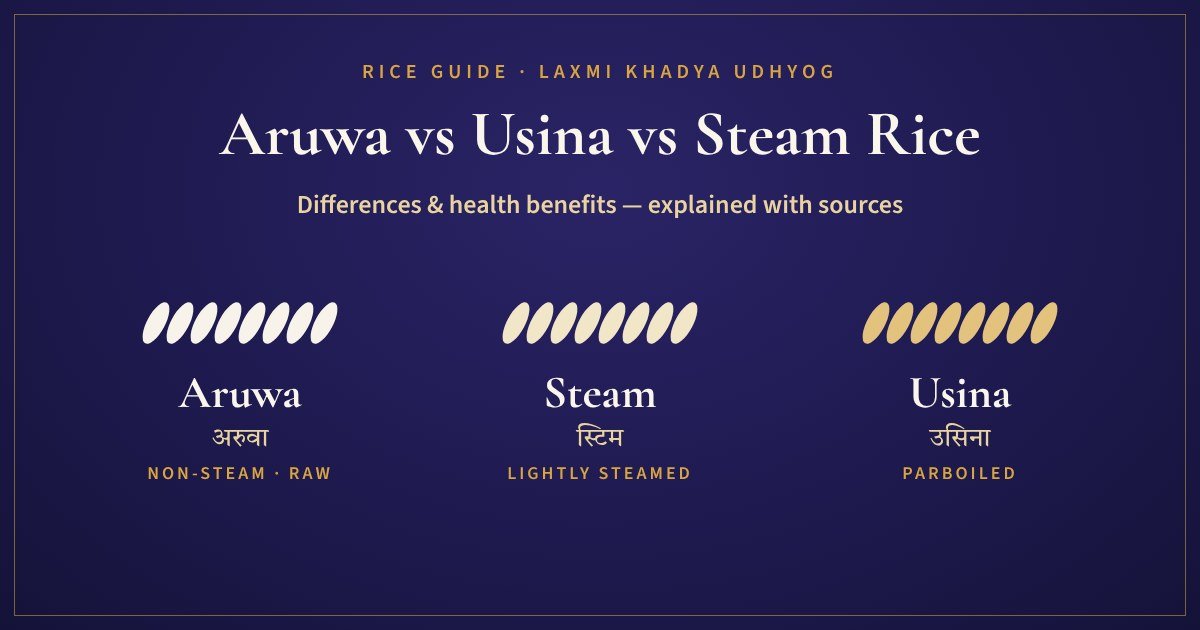
The short version: aruwa is milled from dried paddy with no soaking or steaming, so it stays white, soft and fragrant and cooks quickly. Usina is parboiled, which keeps more B vitamins in the grain and gives a smaller rise in blood sugar. Steam rice is a lighter steaming that sits somewhere between the two. All three are gluten-free.
Aruwa (arwa), the rice we make
Aruwa, also written arwa and sometimes called raw or non-steam rice, is the simplest of the three. The paddy is dried and milled straight away. Nothing is cooked before milling, so the starch is left as it is. You get a bright white grain that cooks soft and fluffy and keeps the smell of the variety. Our Sarna Tiger Premium Rice is made this way from local Sona Mansuli paddy.
What aruwa does well is easy to taste. It has a natural sweetness and aroma, it cooks faster than usina,[2] and its soft texture is why many households want it for everyday dal-bhat, pulao and kheer. Like every kind of rice, it is naturally gluten-free.[4]
Where it falls behind is worth saying plainly. When rice is polished white, some B vitamins go with the bran. A 155 g plate of cooked, unenriched white rice gives roughly 3% of the day’s thiamine (B1) and 4% of niacin (B3). The same amount of parboiled rice gives about 10% and 23%.[2] White rice also raises blood sugar faster. In one study of 28 adults, freshly cooked white rice caused a glucose response about one and a half times higher than parboiled rice.[1] None of this makes aruwa unhealthy, but portion size and what you eat with it matter more.
Usina (usna), where the research is strongest
Usina goes by a lot of names: usna, ushna, sella, parboiled. The paddy is soaked, steamed or boiled in its husk, then dried before milling. That heat sets the starch and pushes vitamins and minerals from the outer layers into the grain. The rice comes out a little creamy or golden, harder, and cooks into separate grains that don’t stick.[2]
This is the type with the clearest health evidence. Per 155 g cooked, parboiled rice gives about 10% of daily thiamine, 23% of niacin and 14% of vitamin B6, against about 3%, 4% and 9% for white rice. It also has slightly more fibre and protein.[2] The blood-sugar difference is real too. White rice produced about 1.5 times the glucose response of freshly cooked parboiled rice, and 1.7 times that of parboiled rice that had been cooled and reheated.[1] Studies in people with type 2 diabetes found blood-sugar rises roughly 30 to 35% smaller after parboiled rice.[2]
Two smaller points: cooled parboiled rice forms some resistant starch, which feeds good gut bacteria, and parboiling stops the enzymes that make rice go rancid, so it stores well.[2] The trade-offs are a firmer, chewier bite, a stronger taste and a longer cooking time, around 25 minutes against 15 to 20 for white rice. It is also still not as nutritious as brown rice, and it has a little less magnesium and zinc than white rice.[2]
Steam rice, somewhere in between
Steam rice is a lighter version of parboiling. The paddy gets a short soak and a gentle steaming, then it is dried and milled. Because the soak is shorter than for usina or sella, the grain stays whiter and softer and looks less chalky.[5] You will see it a lot with basmati.
Since it is partly parboiled, I would expect it to land between aruwa and usina for vitamins and blood sugar. I couldn’t find any study that measures steam rice on its own, though, so take that as an educated guess rather than a proven benefit.
Side by side
| Aruwa (arwa / raw) | Steam rice | Usina (usna / parboiled) | |
|---|---|---|---|
| Processing | Dried paddy, milled directly | Short soak, light steam, dried, milled | Soaked, steamed or boiled, dried, milled |
| Colour | Bright white | White to off-white | Creamy to light golden |
| Texture | Soft, fluffy | Firm but soft | Firm, separate grains |
| Cooking time | Fastest | Medium | Longest |
| Taste | Natural aroma, slightly sweet | Mild | Stronger, a bit nutty |
| B vitamins | Lower | Probably in between | Higher |
| Blood-sugar rise | Faster | Probably in between | Slower |
So which one should you eat?
I’ll be straight, even though we sell aruwa. If your main goal is more B vitamins and steadier blood sugar, usina has the better evidence behind it.[1][2] If you care most about taste and a soft, light plate of rice, aruwa is the traditional choice, and it fits a healthy diet when the portion is sensible and the rest of the plate is dal, green vegetables and curd.
If you have diabetes, how much rice you eat and what you eat it with matter as much as which type you buy. Your doctor or a dietitian is the right person to ask about your own diet.
A few cooking tips
Rinse the rice two or three times before cooking to wash off dust and loose starch.
If arsenic in rice worries you, try the “parboil and absorb” method. Boil the rice in fresh boiling water for five minutes, drain it, add fresh water and finish cooking on low heat until the water is absorbed. Researchers at the University of Sheffield found this removed about 74% of the arsenic in white rice and kept the minerals.[3]
Leftover rice is fine if you handle it well. Cooled and reheated parboiled rice gave an even smaller blood-sugar rise in the study above.[1] Just get cooked rice into the fridge promptly and reheat it until it is steaming hot.
About our rice
At Laxmi Khadya Udhyog in Ranjitpur, Khadak-5, Saptari, we make Sarna Tiger Premium Rice, aruwa rice from local Sona Mansuli paddy, along with Laxmi Bhog Sona Mansuli and Kanchhi in 25 kg and 30 kg bags. For prices or bulk orders, call or WhatsApp 980-4797292. There is more on aruwa in our aruwa rice guide.
Questions people ask
What is the difference between aruwa and usina rice?
Aruwa (arwa) rice is milled from dried paddy without soaking or steaming, so it is white, soft and aromatic. Usina (usna) rice is parboiled: the paddy is soaked and steamed before drying and milling, so it is firmer, slightly golden, keeps more B vitamins and raises blood sugar more slowly.
Is usina (parboiled) rice healthier than aruwa rice?
For B vitamins and blood sugar, yes. Parboiled rice keeps more thiamine and niacin, and in a controlled study white rice gave about a 1.5 times higher glucose response. Aruwa has the better natural aroma and softer texture and fits a healthy diet in sensible portions with dal and vegetables.
What is steam rice?
Steam rice is made by giving the paddy a short soak and gentle steaming before drying and milling. It is a lighter process than full parboiling (sella or usina), so the grain stays whiter and softer.
Sources
- Lu LW, Venn B, Lu J, Monro J, Rush E. “Effect of Cold Storage and Reheating of Parboiled Rice on Postprandial Glycaemic Response, Satiety, Palatability and Chewed Particle Size Distribution.” Nutrients 2017;9(5):475. pmc.ncbi.nlm.nih.gov
- Healthline, “Parboiled Rice: Nutrition, Benefits and Downsides” (nutrient figures from USDA FoodData Central; summarises clinical studies in people with type 2 diabetes). www.healthline.com
- University of Sheffield, “New way of cooking rice removes arsenic and retains mineral nutrients” (Menon et al., Science of the Total Environment, 2020). sheffield.ac.uk
- Coeliac UK, Grains: which are gluten free. www.coeliac.org.uk
- Mahmood Rice, Steam Basmati: how steam rice is processed. mahmoodrice.com
- Veer Overseas, “What are Usna and Arwa Rice and their Health Benefits” (the article this guide builds on). veeroverseas.com
I started from Veer Overseas’ article on usna and arwa rice[6] and checked each of its claims against published research. A few didn’t hold up, such as the idea that arwa rice reduces wrinkles, so I left them out. This is general information, not medical advice. — Mukesh, Laxmi Khadya Udhyog
सारांश (नेपालीमा)
अरुवा चामल धानलाई नभिजाई, नउसिनी सुकाएर सिधै कुटिन्छ। सेतो, नरम, बास्नादार र छिटो पाक्ने। उसिना चामल धानलाई भिजाएर, उसिनेर र सुकाएर कुटिन्छ। दाना कडा र अलि पहेँलो हुन्छ, बी भिटामिन बढी रहन्छ र रगतमा चिनी बिस्तारै बढ्छ। स्टिम चामल छोटो भिजाइ र हल्का बाफपछि कुटिन्छ, दुवैको बीचको। तीनै प्रकारका चामल ग्लुटेन-रहित हुन्। मधुमेह भएकाहरूले मात्रा मिलाएर, दाल र तरकारीसँग खानुहोस् र चिकित्सकको सल्लाह लिनुहोस्।