
Sona Mansuli and Kanchhi paddy are now coming into our mill and the other mills all over Nepal, and the first prices of the 2083 season are set. This post records those opening rates, sets them against what is happening across Nepal and across the border in India, and gives our honest reading of where prices could go over the next few months. Where a number is what we are seeing in the trade rather than a published figure, I say so.
Opening prices at Bayalbas mills
These are open-market rates being paid by rice mills in Bayalbas at the start of the season. They are not government prices.
| Paddy (open market, Bayalbas mills) | Opening rate per quintal | Condition |
|---|---|---|
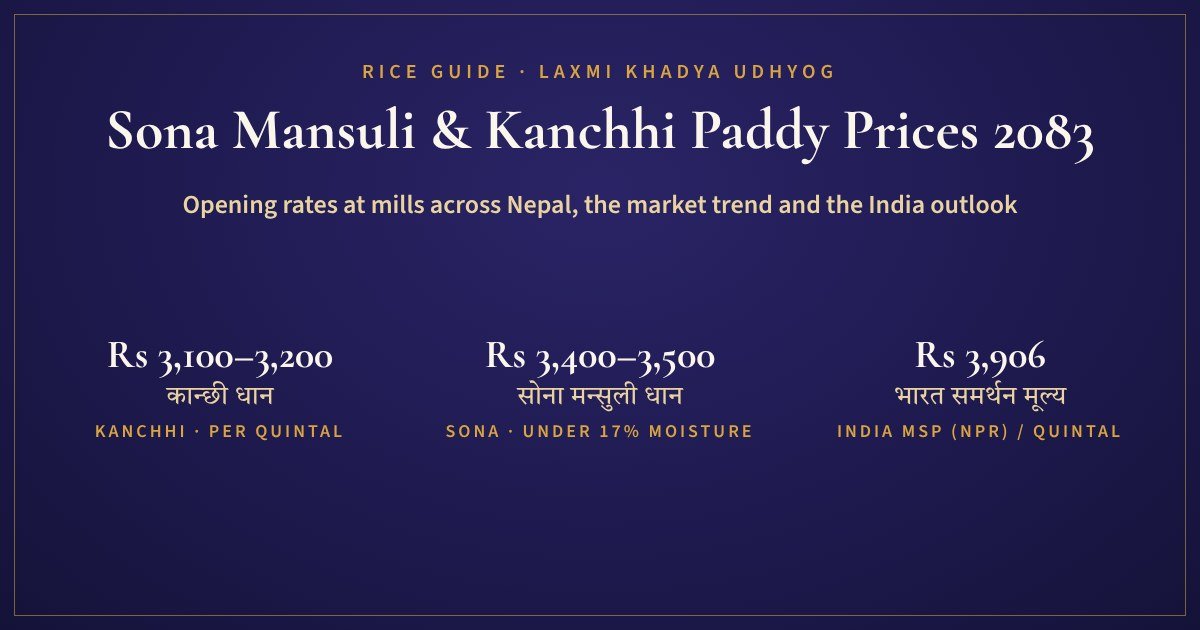
| Kanchhi | about Rs 3,100–3,200 | fresh new-crop paddy |
| Sona Mansuli | about Rs 3,400–3,500 | moisture under 17% |
Two things are worth explaining. First, Sona Mansuli is carrying a premium of roughly Rs 300 a quintal over Kanchhi, which is normal: Sona Mansuli is the medium-fine grain most households in the Terai and the hills ask for, and its rice sells for more. Second, the Sona Mansuli price comes with a moisture condition. Paddy straight from the field is often well above 17% moisture. It loses weight as it dries and can heat up or go mouldy in a stack, so mills pay the full rate only for paddy that is already reasonably dry and cut the price for wetter lots. For a farmer, a few more days of drying on a clean surface can be worth real money.
For context, in our harvest outlook post we wrote that yields around our mill in Saptari look 40–50% higher than last year’s drought-hit crop. More paddy arriving at the same time is one reason opening prices for these everyday varieties are calm, in contrast with the sharp early jump in katarni (jeera masino).
What prices look like across Nepal
Government support price. For this season the government has fixed Rs 3,660 a quintal for coarse paddy and Rs 3,860 for medium paddy, which includes Sona Mansuli[1][3]. Last season the same prices were about Rs 3,464 and Rs 3,628[4], so the official floor is up a little over 6%.
But very little paddy is being bought at that price. The Food Management and Trading Company has a target of 150,000 quintals this fiscal year, and as of 3 Mangsir it had bought only 2,529 quintals, all at its Dhangadhi office. Its other offices, including Lahan, Biratnagar, Janakpur and Birgunj, which have Sona Mansuli quotas, had not yet bought any[1]. Even at full target, government buying is a tiny share of a crop that was about 5.9 million tonnes in 2024/25[4]. So the price farmers actually get is set by mills and traders, not by the support price.
Open-market rates vary a lot by region. In Bardiya, local traders were paying about Rs 2,900 for coarse paddy and Rs 4,000 for fine varieties in mid-November, and some farmers sold coarse paddy for as little as Rs 2,800[2]. Last year, traders in Banke paid Rs 2,500–2,600, about Rs 1,000 below the guaranteed rate[4]. Against that background, Rs 3,400–3,500 for dry Sona Mansuli in the east is a fair opening, even though it is below the Rs 3,860 support price on paper.
Rice prices came into this harvest high. Over the summer, rice in Nepal rose by Rs 300–400 a 25 kg sack in two months, and traders blamed higher prices in India[5]. By August, paddy was up about Rs 800 a quintal, rice up as much as Rs 15 a kg, and Sona Mansuli rice was selling at around Rs 1,750 for 25 kg[6]. At the time, Sona Mansuli paddy (old crop) had moved from about Rs 3,100–3,200 to Rs 3,600–3,700 a quintal[5]. The new crop has opened below that summer peak, which is what usually happens when fresh paddy starts arriving.
Weather was not kind everywhere. Late rain damaged harvested paddy in Kailali, where output may fall 5–7%[7]. A weaker crop in one region can pull buyers towards others, including Madhesh.
The India trend, and why it matters here
Nepal’s rice prices move with India’s, because the border is open and India is our largest source of imported rice. Last year Nepal brought in tens of billions of rupees of paddy and rice from India, and FMTC officials said Indian rice was reaching the border at about Rs 4,000 a quintal[4]. This is what India looks like now:
- Support price up again. India’s 2026/27 MSP for common paddy works out to about Rs 3,906 a quintal in Nepali rupees (₹2,441), up about Rs 115, and about Rs 3,938 (₹2,461) for grade A[5][8]. That is converted at the fixed rate of ₹1 = Rs 1.60. On paper it is above what Nepali mills are paying, but it is only paid to registered Indian farmers at government centres. It is not a price Nepali paddy can get.
- Heavy government buying. Punjab had bought over 169 lakh tonnes by about 10 November, Uttar Pradesh is buying from 1 November to 28 February, and Bihar started on 1 November at 2,385 procurement centres[8][9]. That puts a floor under paddy in the states that border Nepal.
- Smaller Indian crop expected. USDA puts India’s 2026/27 rice output at about 147 million tonnes, roughly 7 million tonnes lower than last year, after a weak monsoon and El Niño[10]. Domestic paddy prices in India are described as firm[10].
- Huge stocks. India’s government rice reserves are around five times its own target, and traders think that makes export curbs less likely this time[13].
- Export prices rising. Indian 5% broken parboiled rice was about $384–389 a tonne in mid-October[10]. Thai 5% white reached $499 on 4 November, its highest since December 2024[11]. Indian exporters at the Bharat International Rice Conference said Indian prices could rise by around $60 a tonne, and that El Niño needs watching into early 2027[12]. Market commentary describes the mood as “cautious firmness”[14].
Put simply: India has plenty of rice in its warehouses, but its new crop is smaller, its farmers have a higher floor, and world prices are climbing. That combination tends to keep Indian rice from getting cheaper, which in turn supports prices in Nepal.
What the next few months could look like
Nobody can forecast paddy prices precisely, and we are not going to pretend to. This is our reading as a mill, based on the figures above and what we see in the trade.
| Period | What we expect | Why |
|---|---|---|
| Mangsir–Poush (now to mid-January) | Broadly steady. Small dips on days with heavy arrivals; dry paddy keeps its premium. | Peak harvest arrivals and a bigger local crop, while Indian prices stay firm underneath. |
| Magh–Falgun (mid-January to mid-March) | Gradually firmer, perhaps Rs 100–300 a quintal above opening for good, dry Sona Mansuli and Kanchhi. | Arrivals thin out, farmers and traders hold stock, and rice demand stays steady through the wedding season. |
| Chaitra onward | Depends mostly on India and the weather. | El Niño, Indian export prices and any change in Indian policy will matter more than local supply by then. |
What could push prices higher: a stronger El Niño hitting India’s rabi crop, a further jump in Asian export prices, or India tightening exports. What could pull them lower: India releasing large amounts of its stocks onto the domestic market, cheap Indian rice coming across the border, or farmers needing to sell all at once for cash.
The Rs 100–300 range is our estimate, not a forecast from any official body. Please treat it as one mill’s view.
What this means if you grow or buy paddy
- Dry before you sell. The Sona Mansuli rate above is for paddy under 17% moisture. Wetter paddy will be discounted.
- Don’t rely on the support price. Government buying has barely started and covers very little of the crop[1]. If you want to try, register early with your local FMTC office; a farmer can usually sell only a limited amount (30 quintals per farmer in Kanchanpur, for example)[3].
- Store well if you plan to wait. If prices do firm after Poush, the gain only matters if the paddy is still in good condition: dry, off the floor, and safe from rats and damp.
- Compare more than one buyer. Rates differ between mills and change week to week during the harvest.
Selling Sona Mansuli or Kanchhi paddy?
Laxmi Khadya Udhyog buys Sona Mansuli and Kanchhi paddy from farmers and traders in Saptari and nearby districts. Call us on 980-4797292 or 984-9899475, message us on WhatsApp, or see the contact page for today’s rate. Our own Laxmi Bhog Sona Mansuli and Laxmi Bhog Kanchhi rice are milled from this paddy and sold in 25 kg and 30 kg bags.
Sources
- Online Khabar, “धान किन्न सरकारी उदासीनता, धनगढी बाहेक सबै कार्यालयमा खरिद शून्य” (government paddy buying stalls), 3 Mangsir 2083. onlinekhabar.com
- Nepal News, “Evening Economic Brief”, 16 November 2026 (Bardiya paddy rates). english.nepalnews.com
- Pardafas, “खाद्य कम्पनीले कात्तिक २७ देखि धान किन्ने, प्रतिक्विन्टल मूल्य ३ हजार ६ सय ६० निर्धारण”, 17 Kartik 2083. pardafas.com
- Nepal News, “Vulnerable Nepali farmers face looming threat of cheap Indian rice”, 10 December 2025. english.nepalnews.com
- Online Khabar, “भारतीय प्रभावले नेपालमा महँगियो चामल” (Indian influence pushes up rice prices in Nepal), Asar 2083. onlinekhabar.com
- Nepal All, “Rice, cooking oil prices climb as government monitoring falters”, 9 August 2026. nepalall.com
- Kantipur, “Heavy rains in Kailali cause damage to paddy fields”, 8 October 2026. ekantipur.com
- BigHaat Kisan Vedika, “MSP list 2026-27” (kharif paddy MSP and state procurement progress), updated 13 November 2026. bighaat.com
- UNI India, “Paddy procurement begins in North Bihar”, 1 November 2026. uniindia.com
- InfoArroz, “India’s rice export market enters a critical phase as global demand meets a tighter supply outlook”, 28 October 2026. infoarroz.org
- UkrAgroConsult (citing Bloomberg), “Global rice prices reach nearly two-year high amid El Niño concerns”, 5 November 2026. ukragroconsult.com
- AgroSpectrum India, “El Niño, freight costs and shifting demand to shape global rice market in 2027: experts at BIRC 2026”, 23 October 2026. agrospectrumindia.com
- To Vima, “Record food stocks may cushion impact of El Niño shock”, 19 June 2026. tovima.com
- CMB News, “El Niño keeps global rice markets on edge as Asian exporters face weather risk”, 5 November 2026. commodity-board.com
The Kanchhi and Sona Mansuli opening prices are open-market rates at rice mills in Bayalbas, not government rates or official statistics. The 40–50% yield increase is what we are seeing locally in Saptari. The price outlook is our own estimate. Everything else is from the sources above, and prices can change quickly during the harvest. — Mukesh, Laxmi Khadya Udhyog
सारांश (नेपालीमा)
सुरुवाती मूल्य: बयलबासका मिलहरूमा यस वर्ष कान्छी धान प्रतिक्विन्टल करिब रु. ३,१००–३,२०० र १७ प्रतिशतभन्दा कम चिस्यान भएको सोना मन्सुली धान रु. ३,४००–३,५०० मा किनबेच सुरु भएको छ। यी खुला बजारका मिल दर हुन्, सरकारी दर होइनन्।
नेपाल: सरकारले मोटो धानको समर्थन मूल्य रु. ३,६६० र सोना मन्सुलीसहित मध्यम धानको रु. ३,८६० तोकेको छ, तर खाद्य व्यवस्था तथा व्यापार कम्पनीले १ लाख ५० हजार क्विन्टल लक्ष्यमध्ये मंसिर ३ सम्म २,५२९ क्विन्टल मात्र किनेको छ। त्यसैले किसानले पाउने मूल्य मिल र व्यापारीले नै तय गरिरहेका छन्।
भारत: भारतमा धानको समर्थन मूल्य प्रतिक्विन्टल करिब रु. ३,९०६ (भारु २,४४१) पुगेको छ, सरकारी खरिद ठूलो मात्रामा भइरहेको छ, नयाँ बाली करिब ७० लाख टनले कम हुने अनुमान छ र निर्यात मूल्य बढ्दो छ। यसले नेपालमा चामलको मूल्य घट्न दिँदैन।
आगामी महिना: हाम्रो अनुमानमा मंसिर–पुसमा मूल्य लगभग स्थिर रहनेछ, माघ–फागुनमा राम्रो र सुकेको धानको मूल्य प्रतिक्विन्टल रु. १००–३०० सम्म बढ्न सक्छ। यो हाम्रो मिलको अनुमान मात्र हो, आधिकारिक पूर्वानुमान होइन।